
Generative Engine Optimisation (GEO): How to Show Up in AI Answers
Generative engine optimization (GEO) helps content get cited in AI Overviews, ChatGPT and Perplexity. What the research and official docs say, and what works.
By Neuravik Editorial · Published · 10 sources
Quick answer
Generative engine optimization (GEO) is the practice of making content easy for AI answer engines such as Google AI Overviews, ChatGPT search and Perplexity to find, trust and cite. It builds on SEO: pages must be crawlable, indexed, answer-first and backed by evidence. In the 2023 GEO study, adding quotations, statistics and citations raised visibility by up to 40%.
In this article
- What is generative engine optimization (GEO)?
- How do AI answer engines find and cite sources?
- What did the original GEO research test and find?
- What does Google say about AI Overviews, AI Mode and your website?
- How do you optimise content for AI answers? A practical checklist
- What is unproven or hype in GEO?
- How do you measure GEO results?
- How Neuravik can help
Generative engine optimisation (GEO) is the practice of making your content easy for AI answer engines, such as Google's AI Overviews and AI Mode, ChatGPT search, Perplexity and Microsoft Copilot, to find, trust and cite. The term, usually spelt generative engine optimization, comes from a 2023 research paper. It now overlaps heavily with what marketers call answer engine optimisation (AEO) or "AI SEO".
This guide separates evidence from noise: what the research tested, what the platforms officially document, what to do, and how to measure it.
What is generative engine optimization (GEO)?
GEO is the work of increasing how often, and how prominently, your pages are used as sources in AI-generated answers. A generative engine is a search system that retrieves web pages and then uses a large language model (LLM) to write one synthesised answer, usually with links to the pages it drew on.
The term was introduced in the paper GEO: Generative Engine Optimization by Pranjal Aggarwal, Vishvak Murahari, Tanmay Rajpurohit, Ashwin Kalyan, Karthik Narasimhan and Ameet Deshpande. It was first posted to arXiv in November 2023 and accepted to KDD 2024, a leading data-mining conference.
GEO, SEO and AEO are industry labels, not formal standards. A practical way to tell them apart:
| SEO | AEO | GEO | |
|---|---|---|---|
| Goal | Rank pages in classic search results | Be the direct answer to a question | Be cited and quoted inside AI-generated answers |
| Where it shows | Ranked lists of links | Answer boxes, voice assistants, AI answers | AI Overviews, AI Mode, ChatGPT search, Perplexity, Copilot |
| Typical measure | Rankings, clicks | Answer appearances | Citations and impressions in AI features |
Google's own position is that these are not separate disciplines. Its 2026 guide, Optimizing your website for generative AI features on Google Search, says "optimizing for generative AI search is optimizing for the search experience, and thus still SEO." In practice, GEO is good SEO plus extra attention to how a page reads when an AI system lifts a passage from it.
How do AI answer engines find and cite sources?
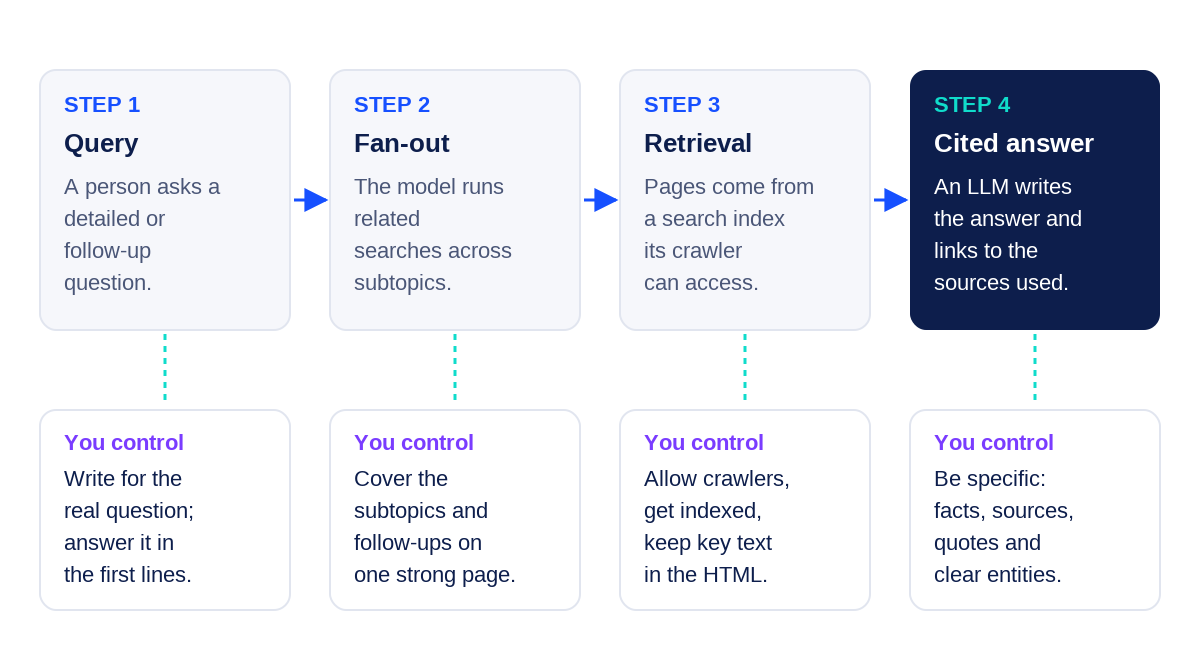
AI answer engines retrieve pages from a search index that their crawler can access, then an LLM writes an answer grounded in those pages and links to the ones it used. If a crawler cannot reach or index your page, nothing else matters.
- Google AI Overviews and AI Mode. Google's guide says its generative AI features "are rooted in our core Search ranking and quality systems". It names two techniques: retrieval-augmented generation (RAG), "also known as grounding", which fetches up-to-date pages from the Search index, and query fan-out, "a set of concurrent, related queries generated by the model to request more information." Google's AI features documentation adds that fan-out lets it show a wider and more diverse set of links than classic search.
- ChatGPT search. OpenAI's crawler documentation says OAI-SearchBot "is used to surface websites in search results in ChatGPT's search features" and that "sites that are opted out of OAI-SearchBot will not be shown in ChatGPT search answers", although they can still appear as navigational links. GPTBot is a separate crawler for content that may be used to train OpenAI's foundation models, so robots.txt can treat the two differently.
- Perplexity. According to Perplexity's crawler documentation, PerplexityBot "is designed to surface and link websites in search results on Perplexity" and "is not used to crawl content for AI foundation models." Perplexity recommends allowing it in robots.txt. Its user-initiated fetcher, Perplexity-User, "generally ignores robots.txt rules."
- Microsoft Copilot. Bing's AI Performance report, launched in public preview on 10 February 2026, tracks citations "across Microsoft Copilot, AI-generated summaries in Bing, and select partner integrations". Its "grounding queries" are the phrases the AI used when retrieving the content it cited.
What did the original GEO research test and find?
The GEO paper found that adding quotations, statistics and citations to a page made it noticeably more visible in AI-generated answers, while keyword stuffing made it less visible.
The set-up. The authors built GEO-bench, a benchmark of 10,000 queries (8,000 for training, 1,000 for validation and 1,000 for testing) drawn from nine sources and spanning 25 domains. Each query was paired with the top 5 Google search results. Their test engine fetched those five sources and had the gpt-3.5-turbo model write an answer, with an inline citation after each sentence. They then rewrote one source at a time and measured how its visibility changed using two metrics:
- Position-Adjusted Word Count: how many words of the answer are attributed to a source, weighted by where they appear.
- Subjective Impression: an LLM-scored rating built from seven sub-metrics, including relevance, influence and likelihood of a click.
The nine methods tested were Authoritative (more persuasive tone), Statistics Addition, Keyword Stuffing, Cite Sources, Quotation Addition, Easy-to-Understand, Fluency Optimization, Unique Words and Technical Terms.
What they found:
- "The best methods improve upon baseline by 41% and 28% on Position-Adjusted Word Count and Subjective Impression respectively." The abstract rounds this to "up to 40%".
- Quotation Addition, Statistics Addition, Fluency Optimization and Cite Sources performed best. In the authors' words, "simple methods like Keyword Stuffing traditionally used in SEO don't perform well": it scored below doing nothing.
- Lower-ranked pages gained the most. For a source ranked fifth in search, Cite Sources raised visibility by 115.1%, while the same method cut the top-ranked source's visibility by 30.3% on average.
- Results varied by topic. "Law & Government" and opinion questions benefited from added statistics, Cite Sources helped most on factual questions, and Quotation Addition worked best in the "People & Society", "Explanation" and "History" domains.
- On Perplexity.ai, the live engine they tested, Quotation Addition improved Position-Adjusted Word Count by 22% and Statistics Addition improved Subjective Impression by 37%, while Keyword Stuffing performed "10% worse than the baseline".
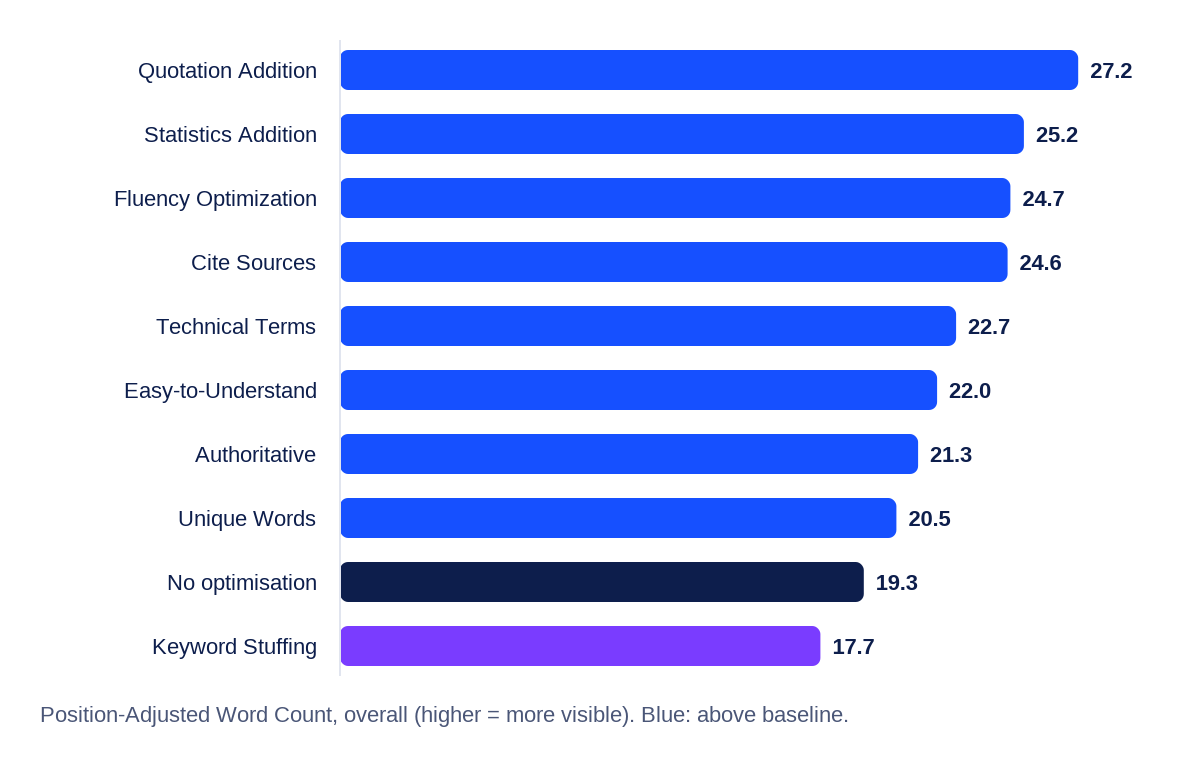
Read these results with care. The experiments ran on a simulated engine built on a 2023 model, changed one source among five, and measured share of the answer rather than clicks or sales. Live engines have changed a great deal since. The direction of the findings (be specific, show evidence, do not stuff keywords) is more reliable than any single percentage.
What does Google say about AI Overviews, AI Mode and your website?
Google says no special optimisation is needed: pages that follow normal SEO best practice are eligible, and the same controls apply. Its AI features documentation states: "There are no additional requirements to appear in AI Overviews or AI Mode, nor other special optimizations necessary." A page must be indexed and eligible to be shown in Google Search with a snippet, and Google adds that "Indexing and serving isn't guaranteed."
The practices Google lists are familiar SEO: allow crawling, use internal links, provide a good page experience, keep important content in text, make structured data match the visible page and keep Merchant Center and Business Profile data current.
Controls. The usual preview controls (nosnippet, data-nosnippet and max-snippet) limit what is shown from your pages in Search, and noindex blocks indexing. Google-Extended is separate: Google describes it as limiting AI training and grounding in some of Google's other systems, not Search. In June 2026 Google also announced a Search Console control that lets site owners choose whether their site appears in, and helps ground, generative AI Search features. "Sites that opt out will not receive traffic or impressions from our generative AI features," and Google says the control "will not be used as a ranking signal for search results outside of these generative AI Search features." After a UK test, it rolled out to all websites worldwide as of 31 August 2026.
How do you optimise content for AI answers? A practical checklist
Start with access and indexing, then make each page the clearest, best-evidenced answer to its question. Each item notes its source.
- Let the right crawlers in. Check robots.txt, CDN and firewall rules for Googlebot, Bingbot, OAI-SearchBot and PerplexityBot. Blocking OAI-SearchBot removes you from ChatGPT search answers (OpenAI). You can block training crawlers such as GPTBot separately if you wish.
- Get indexed and stay technically sound. Verify your site in Google Search Console and Bing Webmaster Tools, keep key content in HTML text rather than images, link to important pages internally and keep pages fast and usable (Google).
- Put the answer first. Open the page and each section with a direct, self-contained answer, then the detail. Bing's guidance says "Clear headings, tables, and FAQ sections help surface key information". Google adds that there is no need to break content into tiny chunks, so write for readers, not for a parser.
- Show your evidence. Cite primary sources, use specific statistics with their year and quote named experts. These were the strongest methods in the GEO research, and Bing notes that "Examples, data, and cited sources help build trust when content is reused". Never invent figures or quotes to look authoritative.
- Be unambiguous about entities. Use the same names for your organisation, products, people and places everywhere. Bing advises aligning text, images and video "so they consistently represent the same entities, products, or concepts." Keep your Google Business Profile and Merchant Center data current (Google).
- Use structured data accurately. Google says no special schema.org markup is needed for AI features, but structured data that matches the visible page still supports rich results.
- Keep content fresh and say when it changed. Bing says "Regular updates help ensure AI systems reference the most current version of your content." IndexNow lets you ping participating engines when a URL is added, updated or deleted; it has support from Microsoft Bing, Naver, Seznam.cz, Yandex and Yep.
- Publish what others cannot. Google recommends original, first-hand, non-commodity content.
- Earn genuine third-party mentions. Because answer engines draw on several sources per question, being covered by trusted publications, directories and review sites puts you into more of the pages they retrieve. This is our reasoning, not a documented ranking factor, and Google warns that "seeking inauthentic 'mentions' across the web isn't as helpful as it might seem."
What is unproven or hype in GEO?
Several popular GEO tactics have no official support, and some are explicitly discouraged.
- llms.txt. llms.txt is a proposal, published by Jeremy Howard in September 2024, "to standardise on using an
/llms.txtfile to provide information to help agents use a website." Google's guide says you do not need to "create new machine readable files, AI text files, markup, or Markdown to appear in Google Search", and that Google Search itself does not use them. The llms.txt site notes that AI labs publish such files for their own developer docs, but it does not claim their models or agents read them. A file is harmless and may help other tools; Neuravik publishes one. Just do not expect it to change your Google visibility. - Chunking everything. "There's no requirement to break your content into tiny pieces for AI to better understand it," says Google.
- Rewriting for AI. Google says you do not need special phrasing or long-tail keyword variations, because AI systems understand synonyms and meaning.
- Pages for every fan-out query. Mass-producing pages mainly to manipulate rankings may violate Google's scaled content abuse spam policy.
- "AI ranking" scores. Google states: "No third-party tool has access to our internal ranking or AI systems." Prompt-tracking tools sample answers, which is useful as a trend, not as ground truth.
- Keyword stuffing. It reduced visibility in the GEO research.
How do you measure GEO results?
Measure GEO with the platforms' own reports first, then add analytics and a fixed set of test questions. No single number captures AI visibility.
- Google Search Console. The Generative AI performance report shows how often links to your site appeared in AI Overviews and AI Mode, with breakdowns by page, country, device and date. Its metric is impressions, and several links from the same site in one AI response count as one impression. Google says it rolled the report out to all websites worldwide as of 31 August 2026, though sites with too few impressions may not see it. Clicks from AI features are included in the main Performance report under the "Web" search type.
- Bing Webmaster Tools. The AI Performance report shows total citations, average cited pages, grounding queries and page-level citation activity across Copilot and Bing's AI summaries.
- Analytics. Track referral visits from AI assistants (for example, chatgpt.com or perplexity.ai) and, as Google suggests, measure conversions and engagement rather than clicks alone.
- A prompt panel. For example, keep a list of 20-50 questions your buyers ask, run them monthly in each assistant and record whether you are cited and how you are described.
For more on search, content and analytics, browse our digital marketing articles.
How Neuravik can help
Neuravik's digital marketing practice works on brand and positioning, performance marketing, content and communication, and analytics and reporting, including content built to be clear, well-sourced and easy for both people and AI answer engines to use. If you want a review of how your site shows up in AI answers, talk to our team.
Frequently asked questions
Is GEO different from SEO?+
GEO focuses on being cited inside AI-generated answers rather than ranking in a list of links, but it rests on the same foundations. Google says optimising for its generative AI features "is optimizing for the search experience, and thus still SEO." Crawlability, indexing and helpful content come first.
How do I get my website cited in ChatGPT?+
Allow OpenAI's OAI-SearchBot in robots.txt, because OpenAI says sites opted out of it will not be shown in ChatGPT search answers. Then make pages that answer questions directly, with specific facts and cited sources. No method guarantees a citation.
Does llms.txt help with AI search?+
There is no evidence it helps in Google. Google says you do not need AI text files or Markdown to appear in Google Search and that Google Search does not use them. llms.txt is a 2024 proposal that some tools may read, so it is harmless to publish one.
How much can GEO improve visibility?+
In the original GEO study, the best methods improved visibility by 41% on Position-Adjusted Word Count and 28% on Subjective Impression in a simulated engine. These are research results on 2023 technology, not a forecast for any site.
How do I track whether AI Overviews show my site?+
Use the Generative AI performance report in Google Search Console, which shows impressions in AI Overviews and AI Mode by page, country, device and date. Clicks from AI features are included in the main Performance report under the Web search type.
Sources
- GEO: Generative Engine Optimization · arXiv (Aggarwal et al., KDD 2024)
- AI Features and Your Website · Google Search Central
- Optimizing your website for generative AI features on Google Search · Google Search Central
- New opportunities, control and insights for website owners · Google
- Generative AI performance report (Search) · Google Search Console Help
- Overview of OpenAI Crawlers · OpenAI
- Perplexity Crawlers · Perplexity
- Introducing AI Performance in Bing Webmaster Tools Public Preview · Microsoft Bing
- IndexNow · IndexNow.org
- The /llms.txt file · llmstxt.org