
AI Readiness Assessment: How to Tell If Your Business Is Ready for AI
An AI readiness assessment shows whether your strategy, data, technology, people and governance can support AI. The dimensions, steps, scoring and red flags.
By Neuravik Editorial · Published · 9 sources
Quick answer
An AI readiness assessment is a structured review of whether an organisation's strategy, data, technology, talent, governance and culture can support specific AI use cases. It scores each dimension against evidence, identifies the gaps that block value, and ends with a prioritised list of use cases and a roadmap for delivering them.
In this article
- What is an AI readiness assessment?
- Why does AI readiness matter so much?
- What does an AI readiness assessment measure?
- How do you run an AI readiness assessment, step by step?
- How should you score AI readiness and maturity?
- What are the red flags that show you are not ready for AI?
- What should you do with the assessment results?
- How Neuravik can help
An AI readiness assessment is a structured check of whether your organisation has what it needs to get value from artificial intelligence: a clear strategy, usable data, suitable technology, the right skills, workable governance and a culture that will adopt new ways of working. It ends with scores, a list of gaps and a short list of use cases you can realistically deliver. Done well, it stops you funding pilots that were never going to reach production.
This guide explains what the assessment covers, how to run one in six steps, how to score the results, which red flags to look for and how to turn the findings into a roadmap.
What is an AI readiness assessment?
An AI readiness assessment is a diagnostic that compares your current capabilities against what your intended AI use cases require. It differs from a technology audit because it looks at the whole organisation, not only the IT stack, and from a strategy offsite because every conclusion is tied to evidence.
A useful assessment answers four questions:
- Where are we today? A score for each readiness dimension, backed by evidence.
- What do our priority use cases need? The data, systems, skills and controls each one depends on.
- What is the gap? The difference between the first two answers, ranked by how much it blocks value.
- What do we do next? A sequenced plan, with owners, costs and success measures.
The output is a decision document, not a certificate. "Ready" only means ready for a specific set of use cases at a specific level of risk.
Why does AI readiness matter so much?
Readiness matters because the gap between prepared and unprepared organisations shows up directly in results. Cisco's 2025 AI Readiness Index, a double-blind survey of over 8,000 senior IT and business leaders at organisations with more than 500 employees across 30 markets and 26 industries, found that only about 13% qualified as "Pacesetters", the most prepared group, a share that has held for three years. Cisco reports that the most AI-ready organisations are 4x more likely to move pilots into production and 50% more likely to see measurable value.
The same 2025 study shows where most organisations fall short:
- 99% of Pacesetters have a defined AI roadmap, against 58% overall.
- 91% of Pacesetters have a change-management plan, against 35% overall.
- 77% of Pacesetters have finalised their AI use cases, against 18% overall.
- 54% of all respondents say their networks cannot scale for the complexity or data volume, and 64% struggle to centralise data.
On its AI Readiness Index page, Cisco adds that 76% of Pacesetters have fully centralised data against 19% overall, and that only 24% of organisations can control AI agent actions with proper guardrails and live monitoring, compared with 84% of Pacesetters.
What does the data say about India?
Indian organisations are adopting quickly but unevenly. According to CRN Asia's report on the India results of Cisco's 2025 index, 17% of Indian organisations are Pacesetters (13% globally), 67% have a defined AI roadmap, 45% have a change-management plan and only 24% have finalised deployment-ready use cases.
Deloitte's State of AI in the Enterprise 2026 India insights, published in March 2026, found that 40% of Indian respondents report significant or full AI usage, against a global average of approximately 28%. The report names regulatory and compliance requirements (39%) as the top AI integration challenge, followed by resistance to change (34%). Both are readiness problems rather than technology problems.
What does an AI readiness assessment measure?
Most frameworks converge on six dimensions. Cisco's index, for example, scores Strategy, Infrastructure, Data, Governance, Talent and Culture across 49 indicators, weighting each pillar by its importance to readiness. We use the same six areas, with process folded into culture because adoption depends on how work is actually done.
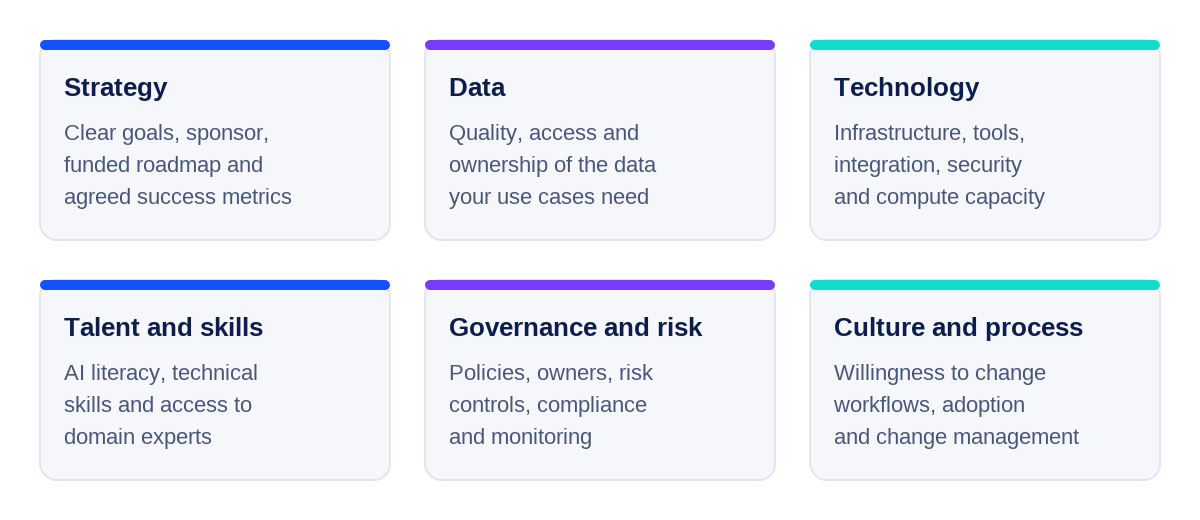
| Dimension | What you check | Evidence to ask for |
|---|---|---|
| Strategy | Business goals for AI, an executive sponsor, funding, success metrics | Board papers, budget lines, a named owner per use case |
| Data | Quality, completeness, access, ownership, labelling, privacy | Data inventory, quality reports, access rules, consent records |
| Technology | Infrastructure, integration with core systems, security, compute | Architecture diagrams, API coverage, security reviews |
| Talent and skills | AI literacy, data and engineering skills, domain expertise | Skills inventory, training plans, partner contracts |
| Governance and risk | AI policy, accountability, risk assessment, monitoring, compliance | Policy documents, risk register, model inventory |
| Culture and process | Appetite for change, workflow redesign, adoption support | Change plans, process maps, adoption of past projects |
Two dimensions deserve extra attention. Data is where many use cases fail quietly: in Nasscom's State of Responsible AI in India 2025 survey of 574 senior executives (fielded October to November 2025), about 43% named lack of access to high-quality data as the biggest barrier to responsible AI implementation. Talent is not only engineers. Models that support specialist decisions need doctors, lawyers or engineers to define what "good" looks like, which we explain in why AI models need domain experts for training and evaluation.
For governance, the NIST AI Risk Management Framework is a practical reference. AI RMF 1.0 was released on 26 January 2023 for voluntary use, and NIST released a Generative AI Profile on 26 July 2024. Its core organises risk work into four functions, Govern, Map, Measure and Manage, with Govern described as a cross-cutting function infused throughout AI risk management.
In India, MeitY unveiled the India AI Governance Guidelines on 5 November 2025. The framework comprises seven guiding principles, recommendations across six pillars of AI governance, an action plan and practical guidelines for industry, developers and regulators. MeitY Secretary S. Krishnan said the focus "remains on using existing legislation wherever possible", so existing rules on data protection and sector regulation remain the baseline for an AI project's compliance check.
How do you run an AI readiness assessment, step by step?
A focused assessment takes weeks, not months. The six steps below work for a mid-sized business or a single division of a large one.
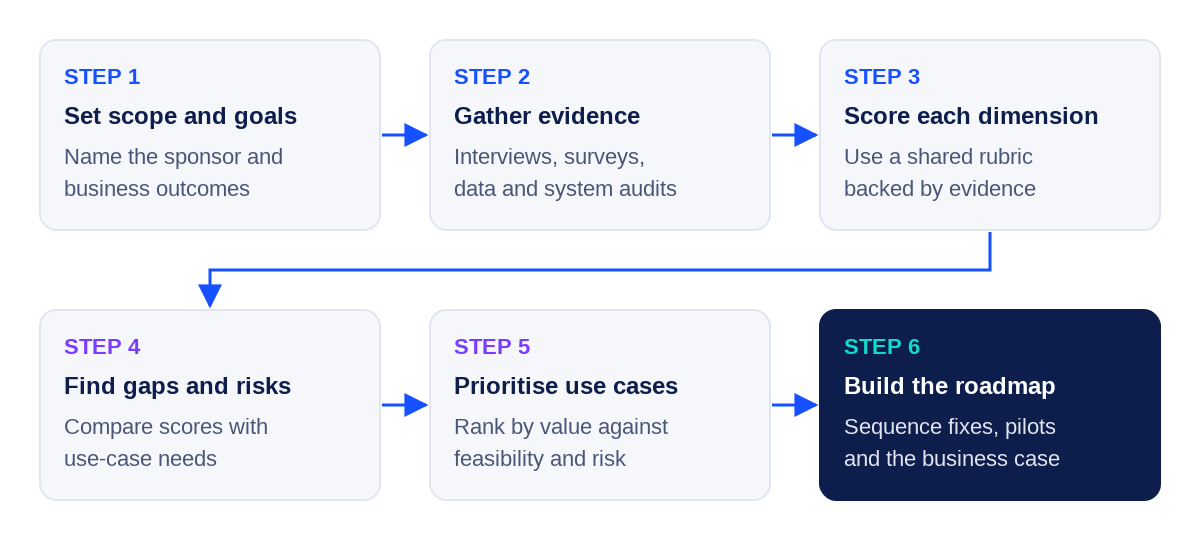
- Set scope and goals. Agree which business units are in scope, who sponsors the work and which outcomes matter (cost, revenue, risk, customer experience). Draft a long list of 10-20 candidate use cases so the assessment has something concrete to test against.
- Gather evidence. Interview leaders and frontline staff, run a short survey, and inspect the actual data sources, systems and policies. Self-reported answers are a starting point, not proof.
- Score each dimension. Use one shared rubric (see below) so that scores from different interviewers are comparable. Record the evidence behind every score.
- Find gaps and risks. For each candidate use case, list the data, systems, skills and controls it needs and compare them with your scores. Map each use case's risks: privacy, bias, errors, security and regulatory exposure.
- Prioritise use cases. Rank them by business value against feasibility and risk. A high-value use case with a data gap may still rank first if the gap is cheap to close.
- Build the roadmap. Sequence foundation fixes, pilots and scale-up, with owners, budgets and the measures that will prove value.
Keep the team small: a sponsor, someone who knows the data, someone who knows the systems, a risk or legal representative, and an independent facilitator who can challenge optimistic answers.
How should you score AI readiness and maturity?
Scoring turns opinions into a comparable baseline. Score each dimension against written criteria, then roll the dimensions up into an overall level.
Cisco's methodology is a good model. It scores each indicator by deployment level (full deployment earns 100%, partial deployment 25-50%, none 0%) and places organisations in four tiers: Pacesetters (86 and above, "Fully Prepared"), Chasers (61-85, "Moderately Prepared"), Followers (31-60, "Limited Preparedness") and Laggards (0-30, "Unprepared"). The tiers apply to each pillar as well as to the overall score.
A second lens is how far AI has travelled through the business. Nasscom's 2025 survey asked companies to place themselves on five levels of AI maturity: new to AI and uncertain about its potential (Level 1); identified promising use cases and testing their value (Level 2); at least one model in production while running a proof of concept (Level 3); at least one AI-based product or service deployed, or a model improving internal operations (Level 4); and AI integral to the business model and integrated across all major functions (Level 5). Maturity tends to travel together: more than about 60% of respondents with a high degree of AI maturity reported matured responsible AI practices.
For example, a simple internal rubric could score each dimension from 0 to 3:
| Score | Meaning | Example for the data dimension |
|---|---|---|
| 0 | Not in place | No inventory of data sources; nobody owns quality |
| 1 | Ad hoc | Some datasets known, quality fixed project by project |
| 2 | Defined | Inventory, owners and quality checks for priority data |
| 3 | Managed at scale | Centralised, governed, AI-accessible data with monitoring |
Two rules keep scores honest. When judging a specific use case, look at the weakest dimension it depends on, not the average, because one missing foundation is enough to stop delivery. And re-score every six to twelve months, since readiness changes as you invest.
What are the red flags that show you are not ready for AI?
Red flags are patterns that predict stalled pilots. If several apply, fix foundations before funding new use cases:
- No named owner or metric. AI is "an IT initiative" with no business sponsor and no definition of success.
- Tool-first thinking. Licences are bought before anyone agrees which problem they solve.
- Data nobody can find or trust. Key data sits in spreadsheets, email or siloed systems, with no owner and unknown quality.
- Pilots that never graduate. Several proofs of concept, none in production, and no criteria for scaling or stopping.
- No AI policy or risk process. Staff paste company data into public AI tools without guidance, and nobody keeps an inventory of models in use.
- Skills concentrated in one person. A single enthusiast or vendor holds all the knowledge.
- No change plan. Workflows, roles and incentives stay the same while the tool changes. Cisco's 2025 finding that only 35% of organisations overall have a change-management plan suggests this is common.
- Unmeasured results. Nobody tracks what earlier digital or AI projects actually delivered.
What should you do with the assessment results?
The results should change what you fund. Turn them into three outputs.
1. A prioritised use-case portfolio. Plot each candidate on value against feasibility. Start with two or three use cases that score high on both, have a willing business owner and need few new foundations. Park the rest, noting the specific gap that blocks each one.
2. A sequenced roadmap. This typically runs in three horizons:
- First 90 days: close the gaps that block the first pilots (data access, an AI usage policy, a risk review), then launch them with clear success measures.
- 3-12 months: scale pilots that hit their targets, build shared data and platform foundations, and start structured upskilling.
- 12 months and beyond: redesign end-to-end workflows around proven use cases and extend governance and monitoring as usage grows.
Deloitte's 2026 India findings show most organisations starting with targeted change: 44% are redesigning select processes while keeping the business model intact, against 17% pursuing fundamental reinvention of core processes and business models. Targeted redesign is a sensible default until early use cases prove their value.
3. A business case per use case. State the baseline, the expected improvement, the total cost (including data work, integration, change management and ongoing monitoring) and the measures you will report. If a use case involves training or fine-tuning a model on human judgement, budget for expert feedback as well; our explainer on how RLHF uses human feedback to train AI models shows what that involves.
For more on strategy, adoption and ROI, browse our AI for Business articles.
How Neuravik can help
Neuravik's AI consultancy practice runs AI readiness assessments and helps organisations with technology strategy, process redesign, and AI roadmaps and business cases. If you want an independent view of where your organisation stands and which use cases to fund first, contact our team.
Frequently asked questions
What is included in an AI readiness assessment?+
Most assessments cover six dimensions: strategy, data, technology and infrastructure, talent and skills, governance and risk, and culture and process. Each is scored against evidence such as data inventories, architecture diagrams and policies, and compared with what priority use cases need.
How long does an AI readiness assessment take?+
A focused assessment of one business or division usually takes a few weeks. Time depends on scope, how many use cases are tested and how easily the team can access data, systems and stakeholders.
What are the levels of AI maturity?+
Frameworks differ. Cisco's AI Readiness Index uses four tiers: Pacesetters, Chasers, Followers and Laggards. Nasscom's 2025 survey used five levels, from new to AI and uncertain of its potential up to AI being integral to the business model across all major functions.
Can a small business do an AI readiness assessment?+
Yes. A smaller business can use the same six dimensions with a lighter process: a handful of interviews, a review of its main data sources and tools, and a short list of use cases. The goal is the same, finding the gaps that would stop a use case delivering value.
What should happen after an AI readiness assessment?+
Turn the results into a prioritised portfolio of two or three starting use cases, a roadmap that closes the blocking gaps first, and a business case for each use case with a baseline, costs and success measures. Re-assess every six to twelve months.
Sources
- Cisco AI Research: The Most AI-ready Companies Outpace Peers in the Race to Value · Cisco
- Cisco AI Readiness Index · Cisco
- AI Readiness Index Methodology · Cisco
- The most AI-ready companies outpace peers in the race to value: Cisco AI Research 2025 · CRN Asia
- Indian enterprises lead global peers in at-scale AI adoption across most functions · Deloitte India
- The State of Responsible AI in India 2025 · Nasscom
- AI Risk Management Framework · NIST
- AI RMF Core · NIST Trustworthy and Responsible AI Resource Center
- MeitY Unveils India AI Governance Guidelines under IndiaAI Mission to Ensure Safe, Inclusive, and Responsible Adoption of Artificial Intelligence across Sectors · Press Information Bureau, Government of India