
Why AI Models Need Domain Experts for Training and Evaluation
Why domain experts in AI training matter: what doctors, lawyers and engineers do, real expert-built benchmarks, and how to source, vet and QA experts.
By Neuravik Editorial · Published · 9 sources
Quick answer
AI models need domain experts for training and evaluation because generalists cannot reliably judge specialised answers. On GPQA, PhD-level experts scored 65% while skilled non-experts with web access scored 34%. Experts write demonstrations, rank and critique outputs, build benchmarks and rubrics, and red team models in fields such as medicine, law, finance and code.
In this article
- Why are generalist annotators not enough for specialised domains?
- What do domain experts actually do in AI training and evaluation?
- What do expert-built benchmarks look like in practice?
- How do you source and vet subject matter experts for AI training?
- How do you brief and quality-control domain experts?
- When are domain experts worth the cost?
- Where does India fit in expert AI training?
- How Neuravik can help
Domain experts in AI training are the doctors, lawyers, engineers, scientists and analysts who write, judge and test the data that specialised models learn from. Generalist annotators can label images or check grammar, but they cannot reliably tell a safe drug dose from a dangerous one. This guide explains why subject matter experts matter, what they actually do, and how to source, brief and quality-control them.
Why are generalist annotators not enough for specialised domains?
Generalist annotators are not enough because, in specialised fields, the hard part of a label is knowing whether an answer is correct, and that takes training most people do not have. A fluent, confident answer about a contract clause or a chest pain symptom can be wrong in ways only a practitioner will notice.
The clearest evidence comes from GPQA, a benchmark of 448 multiple-choice questions in biology, physics and chemistry written by people who have or are pursuing PhDs in those fields. In the 2023 paper, experts in the relevant domain reached 65% accuracy (74% after discounting clear mistakes they identified in retrospect), while highly skilled non-expert validators reached only 34%, despite spending over 30 minutes per question on average with unrestricted web access (Rein et al., arXiv, 2023). The strongest GPT-4-based baseline scored 39%.
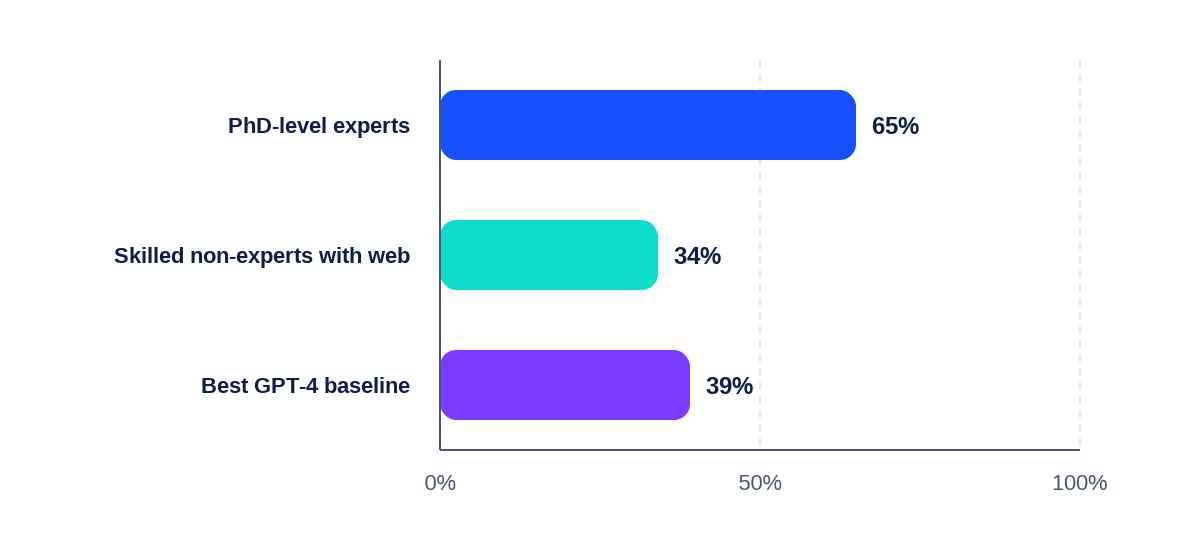
The lesson for anyone building expert data for AI training: searching the web does not turn a generalist into a reliable judge. Three failure modes follow when non-experts label specialised data:
- Plausible but wrong answers get rewarded. If the reviewer cannot spot the error, the model learns that confident errors score well.
- Safety issues are missed. A generalist may rate a medical answer as helpful without noticing it skips an urgent referral.
- Benchmarks stop measuring anything. If test questions or answer keys contain errors, scores reflect noise rather than capability.
What do domain experts actually do in AI training and evaluation?
Domain experts contribute at four points in the model lifecycle: writing demonstrations, giving preference feedback, building evaluations and red teaming. Each uses their judgement in a different way.
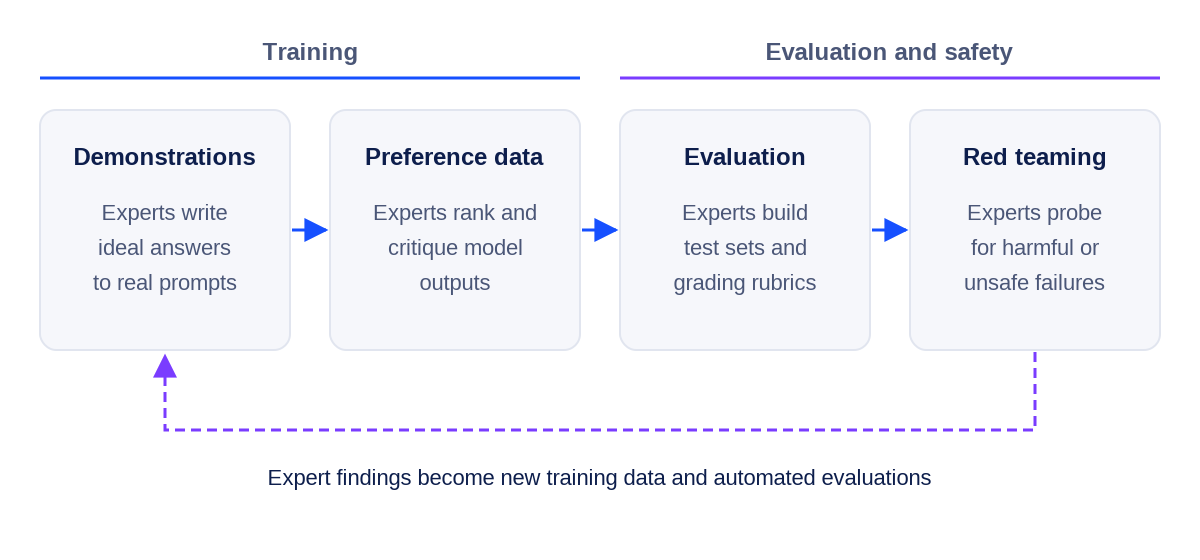
- Demonstrations. Experts write ideal responses to realistic prompts, for example a cardiologist drafting how a model should answer a patient asking about a new prescription. These examples are used for supervised fine-tuning.
- Preference data. Experts compare two or more model outputs, rank them and explain what is wrong. This is the human feedback in reinforcement learning from human feedback (RLHF), which we explain in What Is RLHF? How Human Feedback Trains AI Models.
- Evaluation sets and rubrics. Experts write test questions with verified answers, or rubrics that define what a good answer must and must not contain.
- Red teaming. Red teaming is deliberately trying to make a model fail in harmful ways. OpenAI's 2025 paper on external red teaming says outside red teamers can bring "knowledge of regional politics, cultural contexts, or technical fields like law and medicine", and that red-team prompts often seed repeatable automated evaluations (Ahmad et al., arXiv, 2025).
The loop matters: findings from evaluation and red teaming feed back into new training data. The same paper notes that more capable models need greater human expertise to judge their risks.
What do expert-built benchmarks look like in practice?
The leading AI labs now build their most important evaluations with professionals, not crowdworkers. Five well-documented examples show the range.
| Benchmark | Experts involved | What they built | Year |
|---|---|---|---|
| HealthBench (OpenAI) | 262 physicians who have practised in 60 countries | 5,000 health conversations, 48,562 unique rubric criteria | 2025 |
| GPQA | Experts with or pursuing PhDs | 448 questions in biology, physics, chemistry | 2023 |
| Humanity's Last Exam | Nearly 1,000 subject expert contributors from over 500 institutions in 50 countries | 2,500 questions across over a hundred subjects | 2025 |
| GDPval (OpenAI) | Professionals averaging about 14 years' experience | 1,320 tasks across 44 occupations | 2025 |
| SWE-bench Verified (OpenAI) | 93 software developers experienced in Python | 500 verified coding tasks screened from 1,699 samples | 2024 |
Medicine: HealthBench and Med-PaLM
HealthBench, published by OpenAI on 12 May 2025, was built with 262 physicians who have practised in 60 countries, who between them speak 49 languages and cover 26 specialties. Physicians wrote rubric criteria for each conversation, each with a point value reflecting its importance, including negative points for things a response should avoid. A model grader (GPT-4.1) then scores responses against those criteria, and OpenAI reports that the grader's agreement with physicians was similar to agreement between individual physicians. That is the pattern to note: experts define what "good" means once, then automation applies it at scale.
HealthBench also shows how the expert role shifts. For September 2024 models, physicians could improve on the model's answers; for April 2025 models, physicians' responses no longer improved on them. Writing better answers became harder, so judging answers became the more valuable expert task.
Google's Med-PaLM work took a similar route earlier. The 2022 paper introduced MultiMedQA, combining six existing medical question-answering datasets with a new set of consumer health questions, and a human evaluation framework covering factuality, precision, possible harm and bias. It found that Med-PaLM "remains inferior to clinicians" (Singhal et al., arXiv, 2022). For Med-PaLM 2 in 2023, physicians compared answers to 1,066 consumer medical questions and preferred Med-PaLM 2's answers to physicians' answers on eight of nine clinical utility axes (Singhal et al., arXiv, 2023). Without physician raters, neither claim could have been tested.
Frontier knowledge: Humanity's Last Exam
Humanity's Last Exam consists of 2,500 questions written by nearly 1,000 subject expert contributors, mostly professors, researchers and graduate degree holders, from over 500 institutions across 50 countries. It was published in Nature in January 2026. On the project's leaderboard, GPT-4o scores 2.7% and the best listed model 38.3%, so expert-written questions still separate models where common benchmarks have saturated.
Professional work and code: GDPval and SWE-bench Verified
GDPval, published in September 2025, covers 1,320 tasks across 44 occupations in 9 industries, written by professionals with about 14 years of experience on average. Experienced professionals from the same occupations graded model outputs blind against human deliverables, and OpenAI states its automated grader is not yet reliable enough to replace expert graders.
In code, SWE-bench Verified (August 2024) shows experts improving an existing benchmark. 93 Python developers reviewed 1,699 samples; 68.3% were filtered out for underspecified problem statements, unfair unit tests or other issues, leaving 500 verified tasks. Without that review, models were being marked wrong on tasks that could not be solved as written.
How do you source and vet subject matter experts for AI training?
Source experts by credential and by task fit, then verify both before any paid work begins. A good process looks like this:
- Define the expertise precisely. "Doctor" is too broad. Specify the specialty, years in practice, practice setting (hospital, primary care) and jurisdiction, because clinical guidelines and laws differ by country.
- Verify credentials. Check registration with the relevant professional body, degrees and current practice. For engineers and analysts, check work history and portfolios.
- Run a paid qualification task. Give candidates 10-20 sample items with known answers, including deliberately flawed model outputs. Score both accuracy and the quality of their written reasoning.
- Check for conflicts. OpenAI's red-teaming paper flags that participants with outside stakes may gain unfair early access, so screen for competing interests and use confidentiality agreements.
- Build a bench, not a single hire. Specialists are busy. A pool with overlapping expertise keeps throughput steady and lets you assign two experts to the same item for agreement checks.
The expert networks model exists for exactly this work: a standing, pre-vetted pool you can draw from by specialty. Our expert networks practice covers this sourcing and vetting.
How do you brief and quality-control domain experts?
Brief experts on how models fail, not just on your guidelines, and measure their consistency as you would any annotator. Being a strong clinician or lawyer does not make someone a consistent rater.
- Write a guideline document. Define the task, the rating scale with worked examples at each level, edge cases and what to do when unsure. Version it and log every change.
- Explain model failure modes. Many experts have never reviewed AI output systematically. Show them hallucinated citations, outdated guidance and answers that are correct but miss the user's actual question.
- Calibrate before production. Have every expert rate the same batch, discuss disagreements, then update the guideline.
- Measure agreement continuously. Send a share of items to two experts and track inter-rater agreement. Where experts legitimately disagree, as physicians sometimes do, record it rather than forcing a single answer.
- Seed gold items. Mix in items with known answers to catch drift or fatigue.
- Document findings in a fixed format. The OpenAI red-teaming paper describes prompt-output pairs with a risk category, a risk level and notes on how the level was decided, a structure that works for any expert review.
- Look after reviewers. The same paper notes red teamers can face psychological harm and calls for mental health support, fair pay and informed consent.
These are the same multi-stage quality assurance practices used in data annotation, applied to scarcer and more expensive reviewers.
When are domain experts worth the cost?
Experts are worth the cost wherever an error is expensive and a generalist cannot detect it. Use them selectively, not for every item.
| Task | Generalist annotator | Domain expert |
|---|---|---|
| Formatting, tone, fluency | Good fit | Overkill |
| Clear factual checks with a reference | Good fit with guidelines | Spot-check only |
| Clinical, legal or financial correctness | Unreliable | Required |
| Writing benchmark questions and rubrics | Unsuitable | Required |
| Safety red teaming in a technical field | Limited | Required |
| Adjudicating disagreements | Unsuitable | Required |
A tiered design keeps costs down. For example, trained generalists handle high-volume, low-risk items, while experts write the rubrics, review a sample, handle escalations and settle disagreements. HealthBench shows the extreme version: physicians write criteria once, then a model grader applies them across thousands of conversations. If you are still deciding whether your organisation has the data and processes to run this, start with an AI readiness assessment.
Where does India fit in expert AI training?
India is a large and growing base for AI data work, and its pool of doctors, engineers, lawyers and analysts makes it a natural source of domain experts. A September 2025 article on Ideas for India by Neha Arya of IIT Delhi, citing an Economic Times report based on TeamLease data, says that in 2024 about 50,000 Indian freelance annotators worked on international platforms and about 20,000 full-time annotators worked within India. It also cites a Nasscom (2021) projection that India could serve over US$7 billion of the global annotation market by 2030, up from US$250 million in 2020-21; that figure is a forecast (Ideas for India, 2025).
The same article raises a concern that repetitive annotation can de-skill workers. Expert work is the opposite: it asks professionals to apply judgement. In our view, Indian experts can also offer English alongside regional languages, and local clinical and legal context, which matters for models that will serve Indian users. More articles on this topic sit in our expert networks blog.
How Neuravik can help
Neuravik's expert networks practice sources and vets specialists, including doctors, lawyers, engineers and analysts, for AI model training and evaluation. We pair them with our data annotation team for preference data, rubric design and evaluation work, with documented guidelines and multi-stage quality assurance. To discuss a project, contact us.
Frequently asked questions
What is a subject matter expert in AI training?+
A subject matter expert is a professional, such as a doctor, lawyer, engineer or analyst, who uses their field knowledge to create or judge AI training and evaluation data. They write ideal answers, rank model outputs, build test questions and rubrics, and probe models for unsafe failures.
Why can't regular annotators label specialised AI data?+
They often cannot tell whether a specialised answer is correct. On the GPQA benchmark (2023), skilled non-experts with unrestricted web access answered 34% of questions correctly, compared with 65% for domain experts.
How were physicians involved in HealthBench?+
OpenAI built HealthBench in 2025 with 262 physicians who have practised in 60 countries. They wrote 48,562 unique rubric criteria across 5,000 conversations, and a model grader scores responses against those criteria.
Do you need experts for every annotation task?+
No. Formatting, tone and simple factual checks can be handled by trained generalists. Experts are needed where errors are costly and hard to detect, such as clinical, legal or financial correctness, benchmark design, red teaming and adjudicating disagreements.
How do you check the quality of expert annotations?+
Use a versioned guideline, calibrate experts on a shared batch, send a share of items to two experts to measure agreement, and seed items with known answers. Record legitimate disagreements rather than forcing a single answer.
Sources
- GPQA: A Graduate-Level Google-Proof Q&A Benchmark · arXiv
- Introducing HealthBench · OpenAI
- Humanity's Last Exam · Center for AI Safety and Scale AI
- Large Language Models Encode Clinical Knowledge · arXiv
- Towards Expert-Level Medical Question Answering with Large Language Models · arXiv
- Measuring the performance of our models on real-world tasks · OpenAI
- Introducing SWE-bench Verified · OpenAI
- OpenAI's Approach to External Red Teaming for AI Models and Systems · arXiv
- India's data workers: The human labour making machines learn · Ideas for India